Wednesday, July 30, 2014

Some Kernels of Truth in Historical Fiction

Title: Mrs. Lincoln's Dressmaker: A Novel
Author:  Jennifer Chiaverini
Publisher: Dutton Adult
ISBN: 0525953612
Pages: 352

Abraham Lincoln tends to get all the attention.  He is an iconic leader of America during one of the most difficult eras our nation faced and is admired by many including Barack Obama who has said, "Lincoln is a president I turn to often. From time to time, I’ll walk over to the Lincoln Bedroom and reread the handwritten Gettysburg Address encased in glass, or reflect on the Emancipation Proclamation, which hangs in the Oval Office, or pull a volume of his writings from the library in search of lessons to draw."

However, like many other First Ladies, Lincoln's wife, Mary Todd Lincoln, garnered her own attention during his presidency, and frequently in negative terms.  Mirroring modern times, Mary Todd was criticized for remodeling the White House, extravagant shopping trips, and her choice of attire (foreshadowing the criticisms of  Nancy Reagan and Barbara Bush).  Yet, there was another actor in this drama that has had little attention of the the years - Mrs. Lincoln's modiste or dressmaker,  Elizabeth Keckley.  Drawing on historical documents (Elizabeth's own memoir and Mary Todd's letters), Chiaverini attempts to re-create the domestic scene of the White House during Lincoln's presidency and the aftermath of his death.

Elizabeth Keckley was born into slavery, but purchased freedom for herself and her son.  Moving to Washington DC to set up a business as a free, black woman was not easy, but her talent earned her praise from the DC elite and she eventually sewed for many Congressman and Senators' wives.  This led her to an introduction to Mrs. Lincoln and a long-term commitment to the First Lady.  Being available to Mrs. Lincoln as both dressmaker and dresser, Elizabeth was in the White House for daily events and important functions.  Therefore Elizabeth became confidante and adviser to Mrs. Lincoln, and it is theorized, to President Lincoln himself. Outside of the White House, Elizabeth was active civically and concerned for the newly emancipated slaves with limited resources. Therefore she founded the Contraband Relief Association and spent much of her time volunteering and fund raising for the organization.   After Lincoln's assassination, Elizabeth followed Mrs. Lincoln to Chicago for awhile, and attempted to help Mrs. Lincoln through financial difficulties.  However,  when Elizabeth published her memoir, hoping to defend Mrs. Lincoln from very negative publicity, their relationship was broken.  Elizabeth herself endured criticism for "betraying" the confidence of a house worker and lost many clients. She become poor and moved frequently until she was offered a position at Wilberforce University as head of the Department of Sewing and Domestic Science Arts where she taught, according to the novel, until she had a stroke and returned to Washington DC to live out her life at National Home for Destitute Colored Women and Children, a benefactor of her own work through the Contraband Relief Association.

The Smithsonian wrote an article based on the play mounted about Elizabeth Keckley in spring 2013 entitled Mary T. and Lizzy K. which highlights a few dresses thought to be created by Elizabeth.

Although I have learned about the Civil War, this book sheds new light on aspects of the era that I had never thought about. Chiaverini highlights the daily life of living in a city caught between the North and the South, not only politically, but socially and physically.   DC was frequently under siege or the staging point for wounded soldiers throughout the war. Keckley herself is portrayed as nearly emotionless but heroically hardworking and determined.  As for the other main characters, Mrs. Lincoln is dramatic and moody whereas President Lincoln is thoughtful, stoic yet tormented by his daily decisions to send people into harm's way. 


Tuesday, July 29, 2014

Surviver - before the TV series

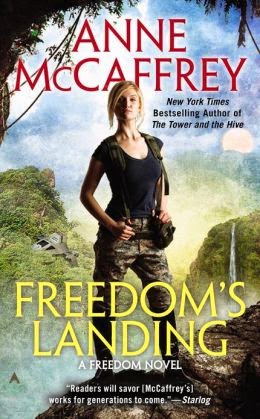
Title: Freedom's Landing
Author: Anne McCaffrey
 Publisher: Penguin Group (USA) Incorporated
ISBN-13: 9780441003389
Pages: 336
 
Could you or I survive when all the comforts of modern life are taken away?  Long before the reality TV shows tackled this question, Anne McCaffrey thought about it and the result is the Catteni series of books, with Freedom's Landing being the first in the set.

Humans from Earth, along with many other species, are kidnapped and enslaved by the Catteni race on a distant planet.  Kris, a woman from Denver, finds the opportunity to steal a speeder and escape to the jungle.  One day, she sees a dog fight overhead and rescues the Catteni being pursued.  Unfortunately, Kris is re-captured and dumped on a completely different planet with hundreds of others, both human and non-human. Angry and confused, the dumped group is rallied by an ex-military sergeant, who organizes supplies and purpose.  Kris again rescues the Catteni, Zainal, by making a case that his knowledge could be valuable.  The motley crew learn the dangers of the planet as they trek toward the hills for shelter and various characters are introduced.

Slowly the caves become home and Kris and Zainal are tasked to lead exploration parties around the planet.  Beyond the various species known, there seems to be a mysterious alien race, dubbed the Farmers,  who had mechanized the planet into a factory farm, leaving behind cattle, fields and robot workers.  The new colonizers take advantage of the discovered technologies and re-create many modern conveniences.   The Catteni continue to drop more colonizers and Zainal, being a high-ranking officer, demands reports and information about the planet, now named Botany. He reveals that the Catteni are only middle management for a race called the Eosi.  As Kris and Zainal develop their relationship, old-fashioned prejudice blooms among some of the disgruntled settlers and threatens the stability of the fragile colony.  As the numbers grow, the settlers continue to expand their living quarters by re-purposing the Farmer's barns.  Hoping to attract the notice of the Farmers, Kris and Zainal led a group to the central command post when a nefarious man, Aarens, sets off a homing beacon. Recalled back to the caves, the homing beacon is noticed by someone - which will be continued in the next book.

Kris, the main character, is determined, direct and self-reliant - a protagonist I tend to admire.  She quickly makes friends and is admired by or lusted after by most she meets.  There are few obstacles she can't overcome or skills she doesn't have, including martial arts and survival training.  However, things go too smoothly to be realistic.  As an escapist read, I enjoyed this book.  It was diverting and easy to read on my phone. Most of the plot points were broadcasted early in the story - no shock that Kris and Zainal got together and that some people don't like it.

Saturday, July 12, 2014

BFFs Forever . . . Unless we get into a fight

Title: The Recipe Club
Author: Andrea Israel & Nancy Garfinkel
Publisher: Harper Collins
ISBN: 978-0-06-199229-2
Pages: 342

As I have mentioned before, I have started collecting and reading food related books.  I started with the China Bayles  mystery series by Susan Wittig Albert which focused on herbs.  Then I discovered a slew of mystery books with main characters who are involved in food-related businesses or hobbies.   The Recipe Club isn't technically a mystery, but the first 50 pages sets up a mysterious secret that drove the two main characters, Lilly and Val, apart for decades.  The story is told in series of emails (modern times) and letters (1960-1970s) as the two girls grow up as best friends who evolve in different directions and are eventually driven apart.

Like the cliche, opposites attract, Val and Lilly couldn't be more different. Lilly is an extrovert and risk-taker, Val is book-smart and reflective.  But both are drawn together because of their difficult family lives.  Lilly's mother is an Broadway actress and her father a psychiatrist.  Val's mother is s recluse (being treated by Lilly's father) and her father is an unsuccessful inventor.  Both feel neglected and misunderstood by their parents.  However, Lilly's father gains some fame from writing up his treatment of Val's mother, and he takes Val under his advisement and grooms her to go to medical school.

Through the course  of ten years, Val and Lilly write each other letters and include recipes to express their current dilemmas.  For example, Cupid's Chocolate Cake for a romantic dinner early in a relationship or Warm Amaretto Milk for homesickness.  Each recipe is tied to the topic in the letter and titled appropriately. According to the end-notes to the book, the recipes were either developed by a chef for the book or drawn from the authors' childhood favorites.  As I was reading, I took notes on several recipes I'd like to attempt.  At the end of the story, many of the Recipe Club's recipes are incorporated into a very special menu.

I enjoyed the unusual format of reading a narrative through letters.  I know there are a few other books out there like this, but I haven't read one in a while.  The authors clearly embodied their characters' voices as they grew up and showed that, although the language and topics may have gotten more complicated over time, the essence of Val and Lilly stayed the same.  A coming of age story for both girls is set in the turbulent times of the sixties and seventies, which exasperates the search for identity and independence.  Yet, as each girl grows older, they grow further apart until innocent actions turn into betrayal.   But, as another cliche states, time heals all wounds, and the grown women learn many secrets of their childhood and re-connect and re-make their friendship.

Many ideas and issues resonant with me as I read.  I think we have all experienced the distancing of a special relationship and wonder what went wrong.  Good intentions are mis-interpreted.  Personalities grow in different directions. At the same time, the book reminisces about wanting to be older, the first kiss, the first crush, and the first break up.  The bitter and the sweet together.

There is an out of date website for the book that includes a quiz (Who are you?), more recipes, and suggestions on how to form your own recipe club.  Since the book was published years ago, there hasn't been any recent activity on the site.


Sunday, April 27, 2014

Re-Reading Anne McCaffrey

I discovered Anne MacCaffrey in college and read through as many of her books as I could get from the local library.  I loved her strong female protagonists and they often inspired me to forge my own paths in difficult times.  I often thought, "How would Menolly handle this? Or, what would Lessa do?"  In the years since my first readings of the Pern series, I've finished college, worked, got my Masters degree, worked in three different countries, returned for my doctorate, and am now instructing at the college level. Returning to favorite characters and places and see how they fit in my new world view could be either disappointing or rejuvenating.  Fortunately, immersing myself in Pern was comforting and like meeting a long-lost friend.

In the past few months, I've read or re-read the following Pern books (I tried to do them in Pernese chronological order:
  • Dragonsdawn 
  • The Chronicles of Pern: First Fall 
  • Dragonsblood 
  • Dragonseye
  • Dragon's Fire 
  • Dragon's Kin
  • Dragon Harper
  •  Dragonheart
  • Dragonsblood 
  • Dragon's Time
  • Sky Dragons 
  • All the Weyrs of Pern
  • The Dolphins of Pern 
  • The Skies of Pern (2001)
I've been craving tubers and klah, so I looked up some Pernese recipes and some of the axillary books such as The People of Pern by Anne McCaffrey and Robin Wood (a portrait book of some of the major characters).

Klah Recipe - a cinnamon coffee
Meat Rolls - a compact meal (with pictures on this blog)
Multiple recipes from the fan forum

I've also re-read Killashandra and for the first time, read the two sequels,  Crystal Singer and Crystal Line.   In college, when I first read Killashandra, I admired the audacity and fearlessness of Killashandra.  But in this second reading, I was a bit more sympathetic to the complaints of her peers and trainers.  She was arrogant and inflexible in the first book, though she mellowed through the others.  It is interesting how a reader's perception of a book can change over time.  And, if a book is good enough, it is worth a second or third read.

As Joan Wickersham, in her blog post,  "The joy of re-reading" states, "Re-reading never gets old. The books change because we change."

Sunday, April 13, 2014

Imperfect BIrds, Imperfect People


Title: Imperfect Birds: A Novel
Author: Anne Lamott
Publisher: Riverhead Trade
ISBN: 1594485046
Pages: 336

Anne Lamott is best known for her writing advise book, Bird by Bird. But, my book club raved bout some of her other works. The digital library had this one available, so I tried it.

I had a lot of difficultly getting into the book at first. The main character, Elizabeth, a middle-aged wife and mother, has difficulty dealing with reality. After her first husband died, she began drinking and had a break down. Her second husband, a writer, helped her pull through it, but she is still quite fragile. Her daughter, Rosie, portrays herself as a good girl, but has fallen into the drug scene in the town and frequently betrays her parents.
 
 For the first half of the book, her parents are in denial, but when confronted with reality, they have to make difficult decisions about her fate. The narrative and believability picks up in the second half of book. As does the likability of all the characters. It is a challenging book to read, as it reveals nasty parts of human nature, ones I prefer not to dwell on. But, there are glimmers of hope for healing at the end.

Sunday, March 16, 2014

Learning Something New

Title: Bobbed Hair and Bootleg Gin
Author:  Marion Meade
Paperback: 368 pages
Publisher: Mariner Books
ISBN-10: 0156030594

Much of the 21st century classic literature list in many high schools draw from the American writers of the 1920s - Hemingway, Fitzgerald, Thurber.  But more neglected are the women writers of the time - Dorothy Parker, Zelda Fitzgerald, Edna St. Vincent Millay, and Edna Ferber.  I stumbled on this audiobook through my library and am very glad that I did.  It has given me a new perspective of these writers and my image of the Roaring Twenties.

Each of these woman resisted the traditional image of what women could do and be during the early part of the 20th century. Each of them earned their own money as a writer and made a lot of their own choices in where they lived, who they lived with and what assignments to take.  Parker was married, but was most often without her husband.  Zelda, often known as the wife of Scott, was a writer in her own right (at times, earning more than Scott) and pursued professional dancing later in life to prove that she could do it.  St. Vincent, as a young woman, was dynamic and irresistible to many men.   She flitted from man to man until she settled, a bit with one who became not just her husband, but her manager, secretary and nurse.  Ferber, author of Showboat and Cimarron, wrote fiction, non-fiction, articles and was both a serious journalist and a playwright. 

Like the famous men of the era, these women spent the Roaring Twenties roaring.  alcohol was the foundation of most social engagements and binge drinking was more the norm than unusual.   The literary circle in New York was fairly small - meeting at the Algonquin Hotel and using the same publishers and editors - and the circle greatly influenced each other. Many writers of the time also lived for extended time in Europe, and especially Paris, where Hemingway's influence became more pronounced.

However, what most surprised me was the portrayal of the 1920s.  It was difficult to imagine the setting with model T Fords, grainy sepia pictures and short flapper dresses rather than the modern New York of crowded streets, high fashion and business, and constant travel.    At times the story reads like a Kardashian reality show - with affairs, drugs, abortions, attempted suicides, nervous breakdowns, and rivalries.   Although I know the 1920s was an era of massive change - socially, politically and economically - my image has often been more like ancient history, rather than modern.  This books made me re-adjust how I think about the time period and has led me to re-discover these writers. 

The style of the book is chronological - each chapter is a year and the narrative switches between each of the authors and highlights important events or incidents during the year.  Therefore the book
is written a bit more like sound bites, rather than an authoritative biography.  Marion Meade has also written a more detailed biography of Dorothy Parker and there are many other biographies of the other women. But, when a book spawns further investigation into its subjects, I think that is a sign of a good book. 

Thursday, March 13, 2014

Family Secret, National Embarrassment

Title: Sarah's Key
Author:Tatiana de Rosnay
Publisher: St. Martin's Griffin; 1st edition (September 30, 2008)
Language: English
ISBN-10: 0312370849
 
I'm a sucker for historical fiction, and I'll blame/commend my dad for that. He was always interested in history and taught me to love it too. Like many other adolescents, I had my phase of reading through all the Holocaust books available for young adults - the ubiquitous Anne Frank, plus some fiction titles. I moved on to non-fiction adult titles, all in a quest to understand, like many others have asked, "How could it happen?"
 
Not long ago, I read and posted on "The Book Thief" which was clearly a fictional creation as the narrator was Death himself. In Sarah's Key, the narrator is a modern woman, Julia, trying to investigate a family secret and a French national embarrassment. Wrapped around the mystery is her disintegrating marriage to a French man and her re-emergence as an independent woman.  Spoiler alert - do not read if you don't want to know the plot.  There are some interesting surprises!

 
Julia, an American-born woman, inherits from her French husband's grandmother, an apartment in Paris. At the same time, as a journalist, Julia is assigned to report on a commemoration of the Vel' d'Hiv Roundup.  As the Nazis occupied France, they coerced the local population and police into rounding up and deporting the Jewish adult population to the concentration camps.  However, the children were left behind in horrible conditions.  It is a part of French history that many wish to forget, as Julia is reminded by several people.
 
Flashing back in time, Sarah locks her brother into a hiding place in their apartment to keep him from the round up.  Not knowing the true intention, Sarah assumes that she will be back for him.  However, she and her parents are confined to an arena, and then separated. Her parents are shipped off and she is confined with the other children.  She convinces another child to escape and they are taken in by a sympathetic older farming couple.   However, her friend, being ill is both seen by and betrayed by a doctor, leaving Sarah with the older couple, desperate to return to Paris and free her brother.  Disguising her as a relative, the couple takes Sarah to the apartment, to find the decomposed body of her brother in the locked cupboard.  A new family occupies the apartment - Julia's husband's family.

 
Through Julia's investigation, she follows the trail of Sarah from Paris, to the US, and then to Italy.  Her husband's family both dread and are relieved to have the family secret in the open.  As Julia gets deeper into the story of Sarah, her marriage begins to dissolve.  But, Julia re-discovers her own personality and passions.

 
The constant shift of time and narrator at times was distracting.  Just as I began to visualize the story, it shifted to a new place and time.  At first I found Julia a bit whiny, but over time I began to understand how she had become who she was.  However,  my greatest sympathies, of course, were with Sarah, who had survived the Holocaust, but could never get past the guilt of that survival.